Pages

Oct 1, 2018

The departure of His Excellency, Mr. Ambassador Kisaburo Ishii

Three years passed in no time and here we are, emotions all over us, listening  the good bye speech of a man who, together with his wife, had the most impressive impact in the continuously improving relations between Romania and Japan - economic, politic and cultural.

Under Mr. Ishii's watch, the Prime Minister of Japane, Mr. Shinzo Abe and his wife visited Romania -the first visit of this kind, two major economic projects have been brought to the start position, Japan's investment in Romania grew substantially, the bilateral economic exchanges grew and are healthier than ever.
As a small association, active to introduce to the Romanian public the magic of the Japanese culture, we are grateful for the large number of cultural events, for the numerous cultural exchanges, for being able to now choose in Bucharest among 36 or more Japanese restaurants, to study Japanese in many locations, to walk through a Japanese garden or remember the peace of mind sipping a cup of tea in the new Tea House at the National Museum of Art.

YES, now we have a Japanese garden and a reason to long for the Hanami festival in the spring.
And YES, now we have a Japanese Tea House, a Chashitsu, a real Chashitsu at the Romanian National Museum of Art.

The man simply put passion, energy, good will and compassion in everything he did. And his wife, Mrs. Sachiko Ishii did not want to fall behind.
Mr. Kisaburo Ishii and his wife Sachiko are now back in Japan. But they remain in our hearts.

Mr. Ambassador Kisaburo Ishii and Mrs. Sachiko Ishii, we wish both of you good health and the continuation of the good work you do together. Please visit us at any time! You'll be always welcome!
The Good-Bye Party
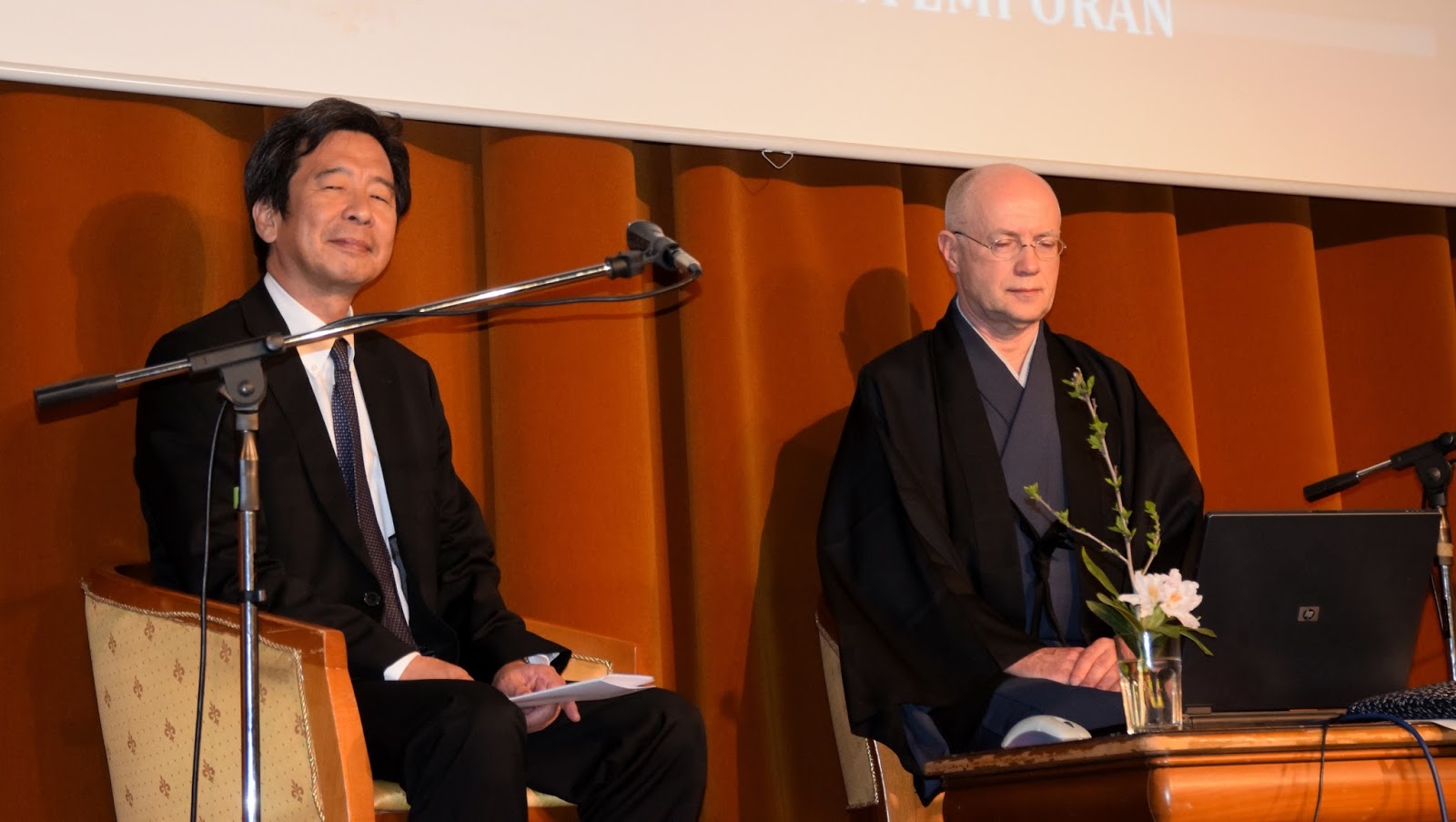
Together with His Excellency Mr. Ambassador Kisaburo Ishii, his wife Sachiko and Prof. Kazuo Tanaka, Technical Director at the Extreme Light Infrastructure Nuclear Physics European Project, currently in implementation in Bucharest.

Chanoyū - offering a cup of tea at the Romanian National Museum of Art


Apr 24, 2018

CHADŌ and ZEN - talking about the impossible at SPIRU HARET UNIVERSITY

This time things discovered a hole in the time fabric and I found myself in a 1950 style auditorium, equipped with a barely surviving PA system and manned by an incredibly warm hearted personnel to whom I will always be grateful for guiding me through the ad-hoc learning of the technology.

With a smile on their faces and a warm cup of tea at the end, they surrounded me with friendship explaining what they believed was an error in the heating system, as the hall was a freezing trap somewhere, away from dusty, humid and very warm atmosphere of the streets of Bucharest on April 19, 2018.

I was at the STUDIO hall of the Spiru Haret University, in the centre of the centre of Bucharest, where I was invited to discuss about Chadō and Zen (two topics one should not easily dare talk about in public) thanks to the kindness of the management and in particular the willingness of a man of vision who happens now to be a good friend, doctor Matei Georgescu - professor at the department of the Science of Education and Psychology.

Dr. Matei Georgescu fights to bring back perennial values into the mainstream educational curricula. The injection of "specialisation" without the injection of basic human values tends to destroy the fabric of society. And we do not want that don't we?

Materialistic values, competition, quick fixes, the race for efficiency lead all to alienation.
Ignoring the food that makes man be human and the human remain human -  the exercise of the humanistic instinct and of the ability to appreciate, study and continuously grow the aesthetic and ethic values fundamental to our civilisation, leads us to nowhere.

Talking about spiritual values, today, when even the word "spirituality" became a confusing abstraction, used anywhere, from a lavatory, to a disco, to a menu of a new age restaurant, is either an impossible task or a task that has to be undertaken with a clean sense of humour and respect.
We chose the second option.


Chadō (the Way of Tea), and Chanoyū  (the Japanese Tea Ceremony), are about the heart and spirit of the Japanese people. Zen, the forever elusive and undefinable teaching, is the spiritual backbone of this Tea Ceremony and is a key ingredient in the fabric of the Japanese soul. Or so it was hundreds of years ago.

The key element here, and the purpose of the conference, was to walk, together with the audience, through the formation and the evolution of this spiritual backbone and to ask ourselves whether the values are today obsolete or just forgotten.
Whether the missing link which many of us feel inside, the seed of anxiety, the fabric of depression, is due to the fact that, while the values present in Chadō and Zen, are perennial, permanently next to us, human beings, we forgot about them, we do not know they can be resurrected, they can again be our friends.
Become again our friends, because while imbibing the morality of a Japan of the XVI century, they transcend the Japanese culture as they represent fundamental human values even today.

The poster, an enthusiastic impromptu of poster art, included all the information possible - nothing was left out.

And placed everywhere to complete the typical Romanian poster infrastructure:


The hall, few moments earlier empty and cold, filled with people who brought their warm feelings and curiosity. Not many people - you do not know what to make of such a title for a conference: Chadō and Zen today. But they warmed up the space with their sincerity and curiosity. A good bunch of people who joined the speaker in a genuine debate.


The Embassy of Japan, was always supportive of such cultural activities. Ms. Yukiko Yasuda - cultural attache and Mr. Takahiko Watabe - counselor / advisor to the Embassy of Japan honoured us with their presence. Mr. Takahiko Watabe offered an eloquent and well focused introduction to the role of the Tea Ceremony in Japan, underlined the importance of such activities and introduced the speaker.


A formal photo session took place prior to the start of the conference.


Sharing cultural values and trying to understand their dimensions, their true meaning, beyond instinctive immediate associations, is a key factor for a good cooperation and expansion of our cultural space. We look forward for more such encounters.

The local paper Opinia Nationala had a supporting review of this event which you may read by clicking on the image below:


Apr 16, 2018

MINDFULNESS visits Calea Victoriei Foundation

MINDFULNESS, a quasi untranslatable word (no wonder, as it has a quasi untranslatable meaning - could anyone imagine the MIND flattering itself, who would be the "flattered", who would be the "flatterer"? ) is the darling of the community of dreamers about the "DREAM" - growing larger and larger today, as the society grows weirder and weirder.

MINDFULNESS is the buzzword of today, replacing YOGA, MANAGEMENT, KARATE, FENG-SHUI, WASABI, ZEN-SUSHI, ZEN-SPAs and other attractors like these.
And, to drive all of us nuts, MINDFULNESS had a pretty noble origin and a very serious intention.

The intention of no one else but Mr. Buddha, many years back, was to structure and format a prescriptive WAY for those who like him, were searching for the Impossible, but lacked the good luck! A WAY to let all of us, hit by the thunderbolt of the Enlightenment, transgress somehow the world of Dualism, of the Subject - Object epistemological dilemma, and finally come to terms with ourselves realising that Impermanence is nothing but Impermanence and this is not too bad at all, as it is what it is.

To do that requires some sort of discipline and codes, lots of codes of prescriptive moral and ethical demeanour, the resources (internal and external) for dealing with RIGHT and WRONG. And of course the discipline NOT to LAUGH as in the end both right and wrong stop making sense or anything else.
All started with the commentaries and the texts interpreting the Divine Revelation of the Vedas and the Dharma. In these texts there was a MUST: always remember the Dharma. But how?

Well, Buddha pointed out to the Suffering as the source of all evils. The source of the Suffering was the Ignorance and Buddha passed the Mandate to control it and a Path to defy it: the Eight folded Path. Among the eight Commands - The Correct Attention, (Samma Sati), at the end of and endless train of translations and interpretations known today as MINDFULNESS.

The whole point is that the Path must be complete. Practicing MINDFULNESS alone, whatever resolution the meaning of the word brings to people's MIND, is a NO STARTER. It is like starting to build the house with the roof. But the today's community of SPA owners, HEALING aficionados, shrink gurus and management consultants have a different opinion.

The Spectre of the Palliative is here with us to stay. There is, a placebo effect. People do benefit sometimes from the effects of applied MINDFULNESS. This perhaps because there are also clever psychologists. In the end, a side effect: there is money to be made and people to be brainwashed happy.

Buddhism, Zen and Chadō are among those paradigms who provide a healthy space for the true practice of the eight folded path. Not only them. But they all point out to discipline and effort. A quick fix - the MUST of today, is not on their list.

The endlessly curious and eager to disseminate culture staff at the Calea Victoriei Foundation decided that an open discussion on this matter may a profitable humanistic and spiritual experience for their public.
And it was. On April 14, on a splendid spring day, our Urasenke Tankokai Romania - Luminis Association presented a conference on the TEA CEREMONY, ZEN and MINDFULNESS followed by the ceremonial serving of a cup of tea for the public. An interactive, intense and enriching experience.

Our sincere thanks to the Calea Victoriei Foundation for their amazing role in maintaining Culture on the pedestal on which it was always meant to stay.

Here are some photos from the event.

A bright room that makes you feel at home ready for its guests

The discussion warms up
The public, focused, gets involved in the conversation


Cristina, the Event Manager, makes sure ALL happens as it should: the right time, the right place, the right message

The discussions unveil a public eager to know, to ask, to challenge, to smile, to critique, to exist.
When we all conclude that MINDFULNESS is of great support when correctly understood and applied as a part of a whole and not as a separate quick fix, it is time to prove it: a good cup of tea will do it!


Many thanks to Alina, Cristina, Elena and Miha for their elegant presence and professional serving of the tea.


Mar 9, 2018

The Romanian Museum of National Art Chashitsu baptised with its first demonstration

"MNAR" - precisely the name of a Viking warrior or an Avatar from the constellation Cygnus Alpha XP-1549.
Well, not really!
This provoking name stands for the Museum of National Art of Romania. But stepping inside, in the belly of the former Royal Palace, gives you the chills of an incredibly touching experience. The sober, glorious and majestic display of confused monumentalism, (trimmed here and there by the presence of ginkgo leaves design metal lacing cage style elevators, silently moving you from a surreal space to another, as you submit slowly to the acceptance of being lost forever), suddenly changes its face, as it spits you inside another universe: a quiet, dust free, temperature controlled white space, a drop of the "impossible" inside of the "possible".

There, on its own, sleeping like a cat, a little Japanese tea house, a Chashitsu with its friend, Roji, the tea garden. The first such construction to ever exist in Romania, grace to an auspicious encounter between the management of the museum, the Japanese Embassy in Romania, a group of remarkably generous sponsors and the talented hands and vision of the Japanese architects and builders.
Never had such a thing been so close to the Romanian public, hands able to feel the texture of the impeccably processed high quality wood, the eyes absorbing the transparency and fragility of the Japanese Shoji paper, the air filled with the smell of freshly washed straws of the tatami. A strange thing, reminding us of the Japan of the XVI century and the birth of the most incredible tradition ever, the Japanese Tea Ceremony. What to do?

What to do? Well, try it out.
We, the Chado Urasenke Tankokai Romania - Luminis Association, had the chance, thanks to the kindness of the museum management and in particular the museum director, Mr. Liviu Constantinescu and Carmen Brad, art historian and the curator of the tea room, to offer a demonstration of a Chaji, (a gathering of tea connoisseurs), for the museum staff who worked with abnegation and joy helping to bring alive this incredible construction - the Chashitsu.

Below, no talk, just images to let you share a bit of our emotions during this brief demonstration. The photos are the results of the presence of the mind and the hand of Andrei Nicolas Stefan, whom I met by pure chance, well in fact by being impressed by his work, who accepted to record this event and whom I strongly suggest you should follow, if you want to be delighted by what we, many times, are ignoring: the beauty of lights, shadows, the eye catching relevance of the detail lost in the sea of the routine and the presence of the human spirit.


Nov 24, 2017

CHANOYŪ and ZEN

The influence of Zen Buddhism in shaping up the spiritual canvas of Chanoyū


Chanoyū, the Japanese Tea Ceremony, completed its forming process as a stable tradition during the XVI century. People were different, the ways were different, the beliefs were different. Yet it was that mentality that gave meaning to Chanoyū. And that mentality included Zen.
About 500 years later Chanoyū still exists, is alive, fashionable I might say, and claims its full grasp of the original form as practically intact. But we are different today. Are we still able to grasp its original meaning and if so to also apply it? If not, what then?
An empire of senses, a heaven of artistic endeavour, Chanoyū survived as a unique tradition due to its spiritual space. Are we still able to grasp that spiritual space today, in the midst of new technologies, new aesthetic perceptions, new popular culture, new media? Do we have to? What would Chanoyū be if voided of its spiritual dimension?

Tea and Zen are One - they used to say 500 hundred years ago. Is this still holding?

To share thoughts on this matter you are kindly invited to a free entrance conference and tea serving organised by Tankokai Romania Luminis during the month of the Japanese Culture . Please see below the required information to register for this event.


VENUE: CENTRUL SEEDS FOR HAPPINESS 

DATA: 29 NOIEMBRIE, 2017 / ORA 19:00

LOCUL: STR. FABRICA DE CHIBRITURI NR. 16 SECTOR 4 / SALA HAPPY

REGISTRATION:

MAIL: info.urasenke.romania@gmail.ro

TELEFON: 0734 681 675

Locurile fiind limitate rezervarea este recomandata si intrarea se va face in ordinea sosirii.

May 5, 2017

BOOK LAUNCH EVENT : THE TEA AND ITS CEREMONY

People dream, things come alive and sometimes books are written, sold, read and while everything should change and become something else, nothing happens except one thing: people dream, things come alive and sometimes books are written.
How could someone have the courage to write a book? To give names to things which have no name or can not have names. To form what does not know form.  To replace the reality with dreams about reality. Why? But, writing books happens. One more time I am wrong. It is reassuring.

I try to practice Chanoyu - the Japanese Tea Ceremony. This is what I do. In rest, one day, one man, who seems to know what he is talking about, tells me: "I am curious by nature and now I am curious about tea. I want to share with people what I learned about this thing called Tea". So far good. But it does not last long. "Could you help me and write about Chanoyu - the Tea Ceremony? We write a book together." I turned slowly my head towards him so I could see his eyes. My mind was void of any possible response.

Chanoyu is pure experience.
Mind, reason and aesthetic pleasure  are left behind, somewhere, to provide companionship for art connoisseurs, for artists, for craftsmen, for intellectuals, for poets, for Maecenas and Patrons of culture and social entertainment, for anyone, for Tea is for everyone. And everyone may have a say about Tea.
Chanoyu is a complete Japanese thing. Know Chanoyu and you know the soul of the Japanese.

During a visit at a museum in Vienna, I came across the following words: "Vulgarity is wanting something that you can't be or can't have. Vulgarity is born during the clash and cooperation present at the intersection of cultures. Vulgarity is when the unique becomes common, too available and is therefore a sign of abuse".
My sensei always told me "do not ask, just practice". Sweet words to replace "do not be vulgar, do not have an opinion or a want before you are ready to have an opinion". As clear and simple as that.

What happens when Chanoyu is practiced by non-Japanese?
Who knows, so many ways, so many minds.
Here in Romania, we are committed to practice with respect for the tradition as transmitted by our Oiemoto in Kyoto and with full awareness that we may in every moment lose focus and slip into the shadows of vulgarity. That should not happen!

I answered: "Yes, I am curious too. I will write this book with you". Knowing the impossible paradigm of writing a book, I want to share and I am curious to see how things have a life of their own, beyond my best possible guess or intuition. I want to talk about the impossible knowing that talking about the impossible is impossible. Things have a life of their own.


A year later, thanks to Mihai Albu, the friend and co-author of this work, the graceful support of the Meditative Arts publishing house, and the support of a group of close friends, the book Ceaiul si Ceremonia lui (The Tea and its Ceremony) is printed out.
The launching event  will take place on Monday, May 22nd at 18:00 at the RENDEZ-VOUS teahouse in Bucharest, on Edgar Quinet street, close to the University Place.
See you there!

Apr 29, 2017

CHANOYU DEMONSTRATION @ GRAND HOTEL CONTINENTAL - BUCHAREST

TIME - although it seems that it exists only in our conscience as a useful invention, one thing is for sure: it passes very quickly in the immediate reality.

Grand Hotel Continental - Bucharest
And here we are again at the majestic Grand Hotel Continental in Bucharest, in our favourite Grigoresco room, ready for a new demonstration of Chanoyu - the Japanese Tea Ceremony.
As always, the event is organised by Calea Victoriei Foundation - an impressive, if not the most impressive culture promoting foundation one may find in Romania.


We arrive the night before and prepare the setup for the demonstration. The hotel personnel helps with grace. It is late, quite, we are exhausted but all is now in place. We are ready for tomorrow morning:

Chanoyu - the never ending question: what is it? Good luck with that! It is whatever you want it to be...... and yet! So we start with the beginning: who are we? what is it that we want? why?
The first part of the program:  LECTURE: Chanoyu as a ritual. Chanoyu as a mythological journey, a journey leaving the day to day noise and disorder to wait in silence, step through the path of purification offered by a roji garden filled with the singing of the birds, freshly splashed with water, to step inside chashitsu, to re-discover the purity, respect and harmony and find in the end the inner peace. The hand of God on your head, sipping the miracle drink you may understand the sense of Oneness. 

Before anything the formal definition of Chanoyu
Hard to take all this in a short time to a public who is open, kind, curious but of course a novice. Try to make sense out of this. But the public is also smart: they understood and stepped into the game.

The first tea demonstration - a tea gathering at 4 a.m. many many years back - on the way to the morning prayers at the temple. A monk and his son arrive to sip a cup of tea in the chill of the morning while the night fades away and the morning light sneaks into chashitsu - Mihai Nishiike had the kindness to help us here and showed to the public what concentration, respect and modesty is all about.
Usucha temae with Hisago dana
Taking sweets


Kansha


The next demonstration: we are now today, 2017 and girls in beautiful kimonos serve tea during a chakai:


Making tea using ryurei chishin dana
The public observes with attention

Purifying the bowl


Offering the bowl of tea


Purifying the tea container


Everyone in the public had the chance to taste a wonderful nerikiri made for this occasion by Miyuki-Do shop and to experiment the taste of Matcha.
All concluded well. Students were happy that we had another successful presentation of the Chanoyu tradition for the Romanian public

Good work done! Congratulations!

Who am I? With all this ZEN I do not know anymore!

Kimono good for tea, Apple good for multimedia 

The team!